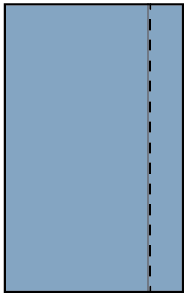
Scant ¼" Seams
Most quilt patterns assume a ¼" seam allowance, but in practice, a true ¼" seam is often too wide. A scant ¼" seam is slightly narrower, allowing pieced units to finish at the correct size, especially in blocks with many seams or diagonal construction.
¼" Seam vs. Scant ¼" Seam
A true ¼" seam measures exactly ¼" from the raw edge to the stitching line. A scant ¼" seam is sewn just inside that measurement, close enough to look the same but narrow enough to account for the fabric taken up when the seam is pressed.
When a seam is pressed to one side, the fold of the fabric uses up part of the seam allowance. If the seam is a full ¼", that fabric loss reduces the finished size of the unit.
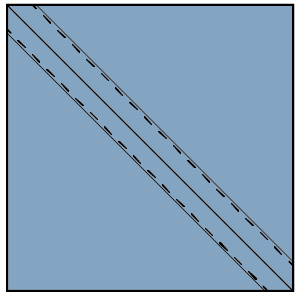
When sewing half-square triangles using the two-at-a-time method, stitch a thread or two inside the ¼" seam line on both sides of the marked diagonal. When the HSTs are pressed open, they should finish at the correct size.
Why Scant Seams Matter
In diagonal piecing, such as stitch-and-flip corners or half-square triangles, the seam allowance sits on the bias and is folded over a longer distance. This uses more fabric than a straight seam and makes these units especially sensitive to seam width.
If the seam allowance is even slightly too wide, the finished unit will be undersized. Across a block or an entire quilt, those small losses add up, leading to blocks that do not match, seams that refuse to nest, or quilt tops that require excessive trimming.
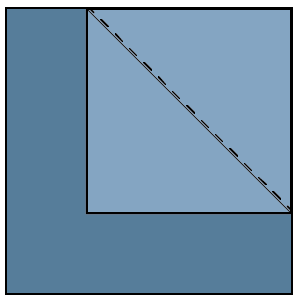
Stitch-and-Flip Corners: Sew just to the right of the marked diagonal. When the corner is flipped and pressed, the triangle will align cleanly with the edges of the larger square.
Scant Seams in Straight Piecing
Scant seams are not limited to diagonal units. In straight piecing, particularly when working with narrow strips or blocks made from many components, a slightly wide seam allowance can still compound over multiple joins.
Using a consistent scant ¼" seam helps maintain accurate unit sizes, improves seam alignment, and reduces bulk where seams meet.
Straight Seams: Even in straight piecing, sewing just inside a true ¼" seam allowance helps maintain accurate unit sizes, especially when blocks include many seams or narrow components.