Spinning Seams
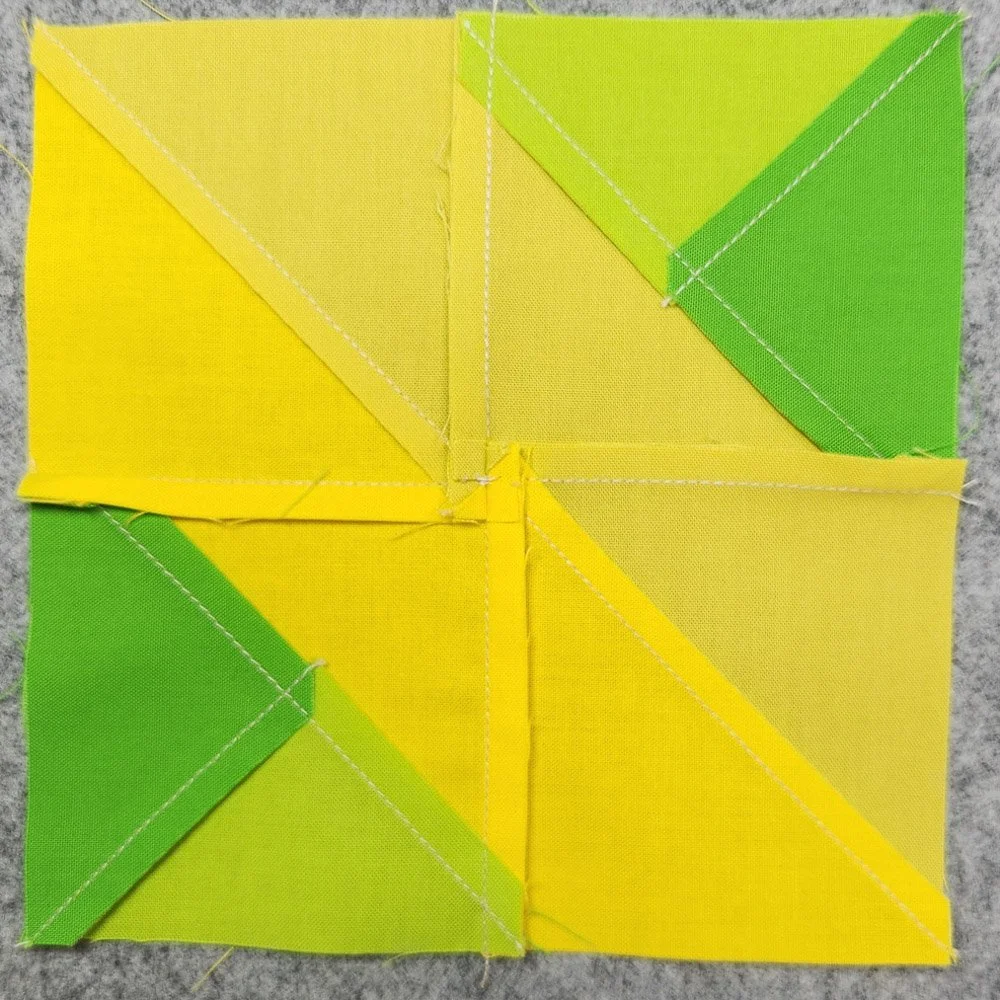
Spinning seams builds on the idea of nesting seams by allowing four units or blocks to meet at one point without excess bulk. When the center seam is opened during pressing, the seam allowances rotate around the intersection, creating a flatter, more flexible join.
How Spinning Seams Work

Sew units together in pairs, pressing the seam allowances in opposite directions so they nest.
Join the two pairs, aligning the nested seams at the center intersection.
After stitching, gently open the seam allowances at the center point using your fingers or the tip of an iron.
The seam allowances will rotate naturally into a pinwheel shape, with each seam pointing in a different direction.
Press to set the seams flat.
The seams distribute bulk around the center rather than stacking it in one place, creating a flatter and more flexible unit.
When to Spin Seams
When four seams meet at a single point, such as in four-patch blocks or hourglass units.
When piecing half-square triangles where diagonal seams intersect at the center of a unit.
When joining rotated blocks or units that form a larger secondary design and need seams to nest at a larger scale.
When reducing bulk at an intersection will help the block lie flatter and quilt more smoothly.